

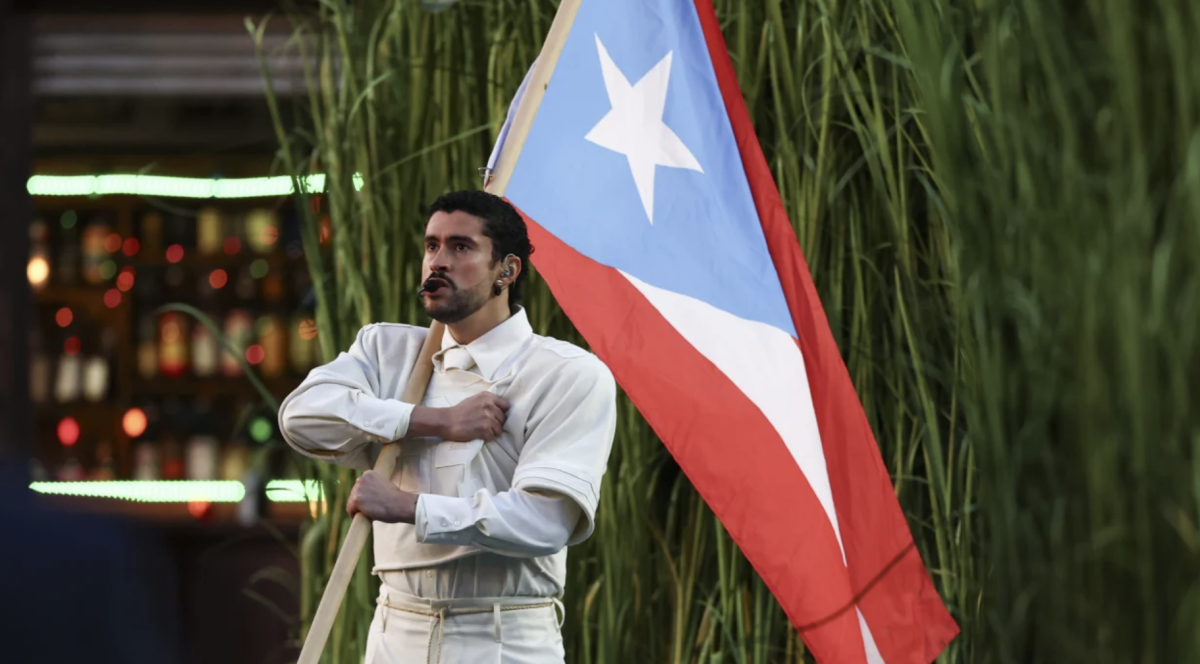
Bad Bunny’s halftime performance was a beautiful representation of Puerto Rico’s rich, deep history of music and practices highlighting its sovereign identity. Bad Bunny, also known as Benito Ocasio Martinez, is known for using his music to raise awareness on issues happening in Puerto Rico during his performances. Many fans and spectators were anticipating him using his platform to call out the injustice happening in the United States: ICE Raids, the Trump Administration taking away rights, and the overall political environment happening in the states. There were also expectations of Bad Bunny to speak about his home country, Puerto Rico. He fulfilled many of the expectations that fans had.
As much support as Bad Bunny had, there was immense backlash for having a Spanish-speaking headliner. Many conservatives made comments, saying, “he’s not an American artist,” “I can’t even understand it,” “he’s going to burn the American flag,” and “I don’t want to see a man in a dress.” It even garnered the attention of political figure Kristi Noem, who was asked if ICE enforcement would be present, “There will be, all over, I think people should not be coming to the Super Bowl unless they’re law-abiding Americans who love this country.” Fox News host Tomi Lahren also said on her podcast, “Tomi Lahren is Fearless,” “He’s not an American artist.” However, Puerto Rico is a U.S territory of the United States since July 25, 1952 but the United States has had control over Puerto Rico since 1898 following the Spanish-American War.
There were even petitions made against the decision since the announcement of Bad Bunny’s halftime show. While many have failed, Turning Point USA decided to make an alternative “All-American Halftime Show”. The concert involved headliner Kid Rock, performances from Brantley Gilbert, Gabby Barrett and Lee Brice as well, garnering 6.1 million viewers. Bad Bunny’s performance officially broke the record with more than 135.4 million views, surpassing Kendrick Lamar’s previous record of 133.5 million views from the Super Bowl halftime show in 2025. According to NBC Sports it was the most-watched halftime show since 2018.
Bad Bunny’s performance starts off with a man in the fields with a guitar, saying “Qué rico es ser latino, Hoy se ve,” transitioning into seeing workers in those fields cutting sugar cane. It was a nod to the island’s agricultural roots, the generation of workers who began in the fields since Puerto Rico was one of the largest sugar cane plantations in the Caribbeans. The same workers in the traditional visual of field workers in white shirts and pants, signifying the slave trade happening in Puerto Rico due to Christopher Columbus invading the Caribbeans in 1492, slavery wasn’t abolished until 1873, a decade after the U.S.
The performers are seen in La Pava hats, a Jíbaro’s straw hat, it’s made from palm leaves that Puerto Rican rural countryside farmers’ wear. It symbolizes their tradition, pride and their Puerto Rican identity. It also became a staple uniform for plena music, the music in Bad Bunny’s album is based on using bomba and plena, Afro-PR dancing and Boricua folk music.
He begins singing “Tití Me Preguntó” walking around the grass fields with a football.
He stops by various vendors, the first is a Coco Frio Stand, Coconut stands which is a blend of cultural, tourism, and street vendors daily life of the island. Next, we see a group of older men playing dominions which is the way community comes together to relax and share stories. Then he walks up towards a stand saying Piraguas, a Puerto Rican shaved ice dessert shaped like a cone. Often sold by street vendors in pushcarts, offering a variety of flavors. He picks one up as he continues his walk towards a taco street vendor giving him the Piragua.
Passing by, we see Puerto Rican and Mexican wrestlers fighting each other. Wrestling, or lucha libre, grew locally but started a new wave when Bad Bunny fulfilled his childhood dream of being on WWE. Last, we see a jewelry vendor trying to convince Bad Bunny to buy his product. Giving him a jewelry box with a ring in it, he’s confused by the ring and hands it over to a couple. The man proposes to his lady, to which she says yes.
Poverty is a central theme showing how Puerto Ricans and Latinos must hustle creatively to get by, having various small, community-based businesses to feed their families.
The song “Yo perreo sola” starts to play as we see a group of people in front of a house, La Casita. A group of women are shown with white and tan outfits, dancing along with the music.
La Casita, the home shown, is not just a set design but a symbol of the community where people gather. In reality, owning a home is exceedingly more difficult in Puerto Rico because of the rising costs, gentrification, and displacement of locals due to tourism and American migration onto the island. When ‘investors’ move in, costs rise, locals are displaced, and las casitas become the investment only for tourists. Puerto Rican culture is displaced as locals are priced out and forced to leave.
“Safaera” starts to play, focusing on Bad Bunny from a bird’s eye view, then different views of the performers as he then sings “VOY A LLeVARTE PA PR” dancing along with Bad Bunny. Soon, the floor under Bad Bunny breaks, and he falls into la casita. We see a family shocked, confused by his appearance, and walks towards the door as a remix of different reggaeton like “Gasolina” playing as we see the dancers performing their hearts out.
“EoO” slowly transitions into the song as Bad Bunny starts saying, “Esta escuchando musica de Puerto Rico, de los barrio, los caceríos,” before he starts singing “EoO”. Bad Bunny can be seen dancing on top of a vintage truck surrounded by more dancers.
The cameras shift into seeing a prompter showing the unofficial mascot of the album, DeBÍ TiRAR MáS FOToS, a frog called El Coqui or Concho, the coqui sings at night when the island goes quiet. But it also represents Puerto Rico’s crested toad, an increasingly endangered species on the island due to non-Puerto Rican tourist dwellings spraying pesticides to kill the animal.
Taken back to the set of long grass, a group of violists starts to play “MONACO”, Bad Bunny begins to say, “Buenas tardes, California. Mi nombre es Benito Antonio Martínez Ocascio. Y si hoy estoy aquí en el Super Bowl 60, es porque nunca, nunca dejé de creer en mí. Tú también deber, tú también deberías de creer en ti. Vale más de lo que piensas. Créeme.” Which translates to “Good afternoon, California. My name is Benito Antonio Martínez Ocascio. And yes, today I’m here at the 60th Super Bowl, it’s because I never, never gave up in believing in myself. You should also believe in yourself. It’s worth more than you think. Believe me.” He then starts singing “Dime, dime esto lo que tú quería?” which means “Tell me, tell me is this what you wanted?”
The shot pans out, viewing a wedding in El Barrio. As the guests and newlywed couple walk out to the party, a guest appearance by Lady Gaga singing a salsa version of “Die with a Smile”.
“BAILE INoLVIDABLE” starts to play after the rendition of Gaga’s song, Bad Bunny dances with various dancers, and the camera flows to show the set. A very memorable moment for many Latinos in this scene is the kid falling asleep on the chairs at a party, since Latinos love to party all night.
Bad Bunny walks off towards the edge of the set, falling into a group of people waiting to catch him to transition off to “NUEVAYoL”. The set shows off a mini–New York, see the famous La Marqueta, a barber shop, and a club entrance.
La Marqueta was an informal network for pushcart vendors; it became an economic and social hub for the area’s Latino immigrant community from the early 1930s to the mid-1950s. It transformed New York’s Spanish Harlem. It wouldn’t be until the “Great Migration” where Puerto Ricans would bring the vibrant culture of the Caribbean to the U.S. In 1917, the Jones-Shafroth Act changed the status for Puerto Ricans recognizing them as U.S. citizens with full rights exercised while living in the U.S. The struggle with poverty worsened due to the lack of jobs for locals and hurricanes ravaging cities, causing many to migrate to the U.S. These migrations paved the way for new terminology, such as the concept of a Nuyorican, originally meant as an insult towards assimilated Puerto Ricans losing touch with their ancestral roots.
A great representation is showing the owner of one of the last surviving Puerto Rican Social Clubs in NYC. Tonita is a legend in the community of the Caribbean Social Club, making sure her address was in view for the world to see, 244 Grand St in Brooklyn.
Then we see a depiction of a younger Bad Bunny viewing himself win the Grammys; Bad Bunny hands the Grammy to his younger self. Many from Puerto Rico are never seen succeeding to such levels, and Benito is showing that success is possible.
Ricky Martin sings “LO QUE PASÓ A HAWAii”. The song reiterates the fear many Puerto Ricans have, not wanting statehood to avoid becoming a second Hawaii. Puerto Rico and Hawaii have a mirrored history. Being territories of the U.S. due to the Newlands Resolution, Treaty of Paris and the Spanish-American War. The lyrics speak up the singer’s concerns about the island’s gentrification and potential U.S. statehood. Martin was one of the first 90s Latin artist to crossover into the mainstream U.S. performing in both English and Spanish.
“Thеy want to take my river and my beach, too. They want my neighborhood and grandma to leave, No, don’t let go of the flag, nor forget the lelolai. ‘Cause I don’t want them to do to you what happened to Hawaii.” (Translated from Spanish to English)
The camera pans out to the powerlines sparking out of power showing alongside the performers.
Bad Bunny is seen holding a different style of the Puerto Rican flag as “El Apagón” begins in the background. Instead of the dark blue triangle, we see a lighter blue flag with the same red and white stripes. In 1892, the design of the flag was for independence from Spain; however, in 1952, when it became an American territory, they were no longer able to wave the previous flag because of the Ley de la Mordaza, Gag Law 1948. It made it illegal for Puerto Ricans to display or own a Puerto Rican flag, even in their own homes. Many were killed, but it was later repealed in 1957.
“El Apagón” references Puerto Rico’s economic issues with the island’s electrical system. It calls out the government because of the frequent power cuts in the island. LUMA Energy, the private energy company taking over the island’s infrastructure. Bad Bunny has famously called both out for the inadequate infrastructure in his July 2022 concert in San Juan.
“CAFé CON RON” begins to play over “El Apagón” melody. As Bad Bunny climbs down from the light post, we see various performers holding every flag from America.
He’s then shown catching a football as he says “God bless America,” going on by naming almost every American country, “ Chile, Argentina, Uruguay, Paraguay, Bolivia, Peru, Ecuador, Brazil, Colombia, Venezuela, Guyana, Panama, Costa Rica, Nicaragua, Honduras, El Salvador, Guatemala, Mexico, Cuba, Dominican Republic, Jamaica, Tila, Antilles, United States, Canada, Modland, mi patria, Puerto Rico seguimos aqui.”
Bad Bunny is teaching U.S. citizens that America is not just the United States, and that Latin Countries are a large defining part of America. U.S. teachings have made us believe North and South America are two different continents due to colonial teachings.
At the end, “DtMF” begins to play, performers taking in Latino pride, as the Billboard in the back shows “THE ONLY THING MORE POWERFUL THAN HATE IS LOVE.”
Bad Bunny’s halftime show wasn’t just a music performance, but it gave Latinos, Hispanics, and Indigenous people have pride in their countries being represented in such a large scale that we haven’t been shown before. You do not need to change yourself to fit in, take pride in your culture.