

Trigger Warning: This story contains mentions of sexual abuse.
On Tuesday, March 17, it was announced that Cesar Chavez had been accused of sexual assault allegations. The United Farm Workers released a statement about the future of the UFW and how they would continue as an organization.
Sexual Abuse of Women and Little Girls
Cesar Chavez Day is a federal commemorative holiday observed on March 31, Chavez’s birthday. In light of these recent allegations against the labor leader and civil rights activist by multiple women, many celebrations have been cancelled or renamed.
Cesar Chavez is one of the founders of the United Farm Workers (UFW) alongside Dolores Huerta and others. On March 18, Huerta spoke out about her experiences with Chavez after staying quiet for over 60 years, where both times she felt coerced and obligated to sleep with him.
In 1960, Huerta says that Chavez pressured her into having sex in their hotel room while they were on a work trip. Another instance was in 1966, when he drove her to a grape field, parked the car in a secluded area, and raped her. In her statement, Huerta wrote:
Huerta says she did not disclose the information to anyone as she did not want the police involved. She doubted that anyone in their union would believe her. Chavez was widely adored and idolized in the UFW.
Both sexual assaults resulted in pregnancies. Huerta recounts that she concealed her pregnancy with baggy clothes that concealed her bump and arranged to have the children raised by other families.
The stories did not end with Dolores Huerta. Before she stepped forward, other women stepped forward.
The New York Times investigated Chavez’s past and found evidence that reinforces the allegations. For the first time in decades, Ana Murguia and Debra Rojas came out with their stories publicly.
Murguia and Rojas are two of Chavez’s youngest known victims, groomed as young as 8 years old. Murguia and Rojas both recounted how Chavez would sexually abuse them in the privacy of his office. Chavez had the trust of the girls and their families since they were followers of his movement. They recognized Chavez as a powerful leader and admired him for his resistance. Chavez had their families’ trust, and he abused it. Murguia had attempted to take her life at 15 and spiraled into a heroin addiction at 19. Rojas developed drinking problems and panic attacks. Both women continue to feel the presence of him in their lives as, until now, Chavez had been widely celebrated every year on the same day. There are highways named after him—buildings and monuments.
Rojas shared that in 1975, when she was 15 years old, Chavez insisted she join him for the 1,000 Mile-March. Its purpose was to educate farm workers of their newly won rights under the state of farm labor law. Chavez kept insisting until Rojas’ father said yes, to be “in his favor” since he was so widely loved. Rojas recalled that her parents loved him.
“We all loved him,” she told the New York Times.
When they reached Stockton, Chavez told Rojas that he was going to send her home. Rojas was waiting at a bus station when Chavez and his bodyguards pulled up in a car and told her to get in. When she did, they drove her to a motel where Chavez raped her with a gun in view.
It was because of the death threats he was receiving, he assured.
Chavez’s History of Abuse
The United Farm Workers led one of the most significant labor and civil rights movements of the 20th century. The farmworkers’ movement of the 1960s and ’70s was a pivotal moment in the history of labor organizing, civil rights activism, and the Chicano movement. Chavez, the co-founder and leader of the United Farm Workers, worked as a farm worker before his time as a community organizer. Chavez channeled his skills into the Delano grape strike, organized by Filipino farm workers, and helped bring together Filipino- and Mexican-American farmworkers under one union. Chavez quickly cultivated a reputation as a charismatic leader with supporters who worshiped him.
As his power and influence over the farmworkers’ movement grew—particularly after his famous fast for “non-violence” in 1968—concerns about Chavez’s increasingly autocratic and manipulative behavior arose. Additionally, Chavez has been depicted in popular history as a symbol of the farmworkers’ movement itself. To this day, farmworkers remain some of the most exploited and unorganized workers in the U.S. As a result, many feel nostalgic for the hope and optimism that the UFW inspired at the peak of its power, especially the people who continue to struggle in the fields—which is partially why Dolores Huerta and other survivors have felt pressured to stay silent about Chavez’s abuse for so long.
From the late 1960s up until his death in 1993, Chavez not only harmed women. Although most are learning of Chavez’s sexual abuse of women and children for the first time, people have called attention to Chavez’s history of abuse for decades. For example, many instances of adultery have been documented, including when his wife left him after discovering a love letter from an 18-year-old. Chavez also adopted elements of the cult, Synanon, including its notorious “Game” into the UFW, using it to verbally attack members and enforce loyalty. Chavez created a cult of personality within the UFW, using public displays of personal sacrifice imbued with religious overtones, including fasts. He especially demanded loyalty and personal sacrifice from unpaid activists who lived at the UFW headquarters and compound, La Paz, where volunteers adopted Chavez’s diet, exercise, and philosophy. Despite nominal democratic elements like an executive board, the UFW’s lack of bottom-up leadership structure gave Chavez near-absolute control over the union. (Notably, throughout the UFW’s history, no local chapters were established—only regional offices staffed by volunteers.)
However, Chavez was criticized by some contemporaries, particularly radical organizers and rank-and-file UFW members. Chavez was criticized for his anti-socialism, proximity to the political establishment, assimilationist politics, public commitment to non-violence, and curated image as a savior of oppressed people. Many Filipinos were rightfully upset when Chavez went to the Philippines and accepted an award from notorious dictator Ferdinand Marcos in 1977.
A crucially divisive moment came in the spring of 1974, when Chavez launched the “Campaign Against Illegals,” for which the UFW spent over $1 million to establish a “UFW Border Patrol” that would report, hunt down, beat, or even rob undocumented people before sending them back to Mexico. This campaign included scapegoating and dehumanizing undocumented farmworkers as “scabs” and “strike-breakers”—as well as using slurs for undocumented people—despite the fact that, according to historian Frank Bardacke, at the time “about half the people working in the California fields were undocumented.” Writers like Bardacke have argued that the UFW’s so-called “wet line” was a deliberate effort by Chavez to scapegoat immigrants so that the union could rebuild a grape boycott and explain why it was losing its labor contracts.
Aftermath on Campus
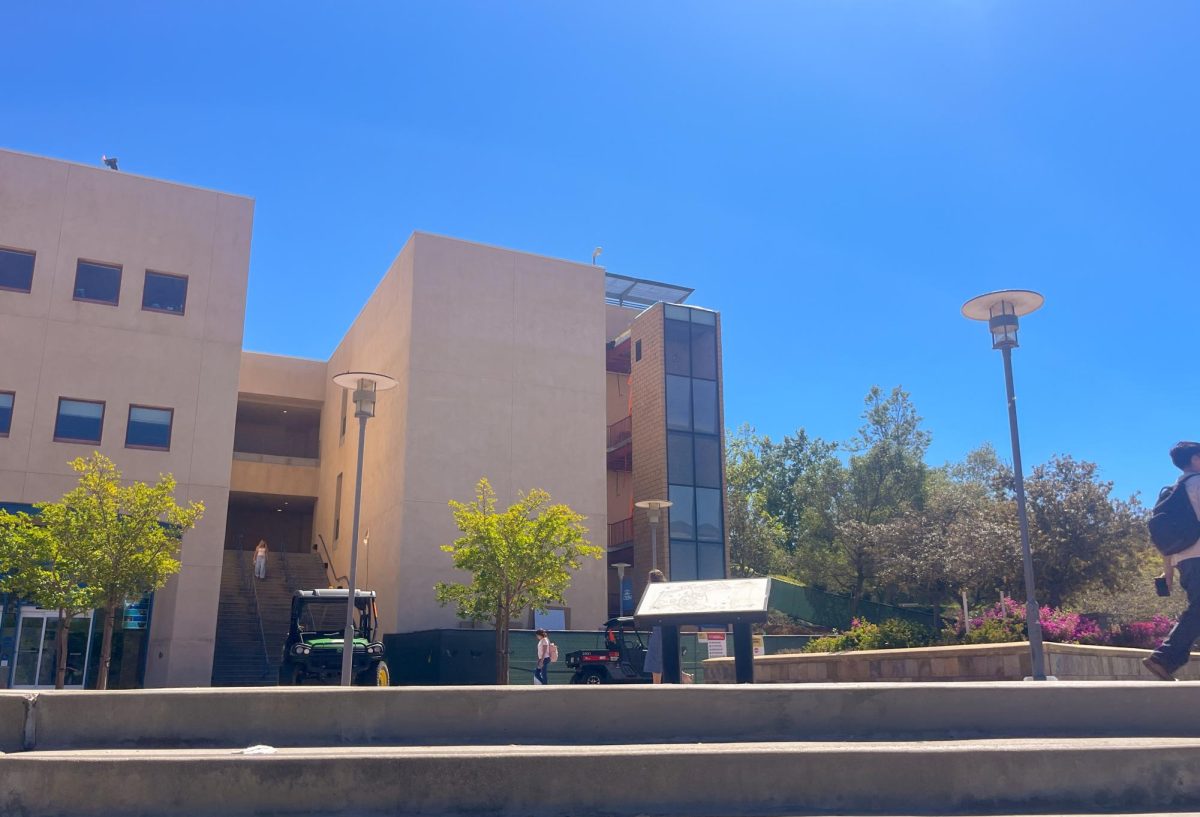
Since the reveal of allegations against Chavez, the California State University of San Marcos has removed the statue of him at Cesar Chavez Plaza.
President Neufeldt shared a statement on March 18 about the reports:
On March 19, Thursday afternoon, President Neufeldt gave an update about the Chavez statue.
The statement also mentioned a Reflection Session for support happening on Tuesday, March 24 at noon during U-hour in Academic Hall 304. There is an email address ([email protected]) to share your thoughts and input on what the CSUSM community should do about replacing the statue. Neufeldt stated that CSUSM will create a webpage to ensure ongoing updates and communication.
On March 20, President Neufeldt announced the removal of the Chavez statue. In her statement, she wrote: “The statue has now been removed. Given the pain expressed by many members of our community, and our responsibility to prevent further harm, we moved as quickly as possible once everything was in place.”
The Cougar Chronicle will continue to follow this story as it develops.
CSUSM has a list of domestic and sexual violence resources and support for students through the Cougar Care Network.
Read our 2024 editorial on Cesar Chavez’s legacy here: https://csusmchronicle.com/23610/opinion/how-should-csusm-commemorate-cesar-chavez/