


On Friday, March 27th, CSUSM hosted the 2026 North County Day of Service. Community members chose from a selection of volunteer project sites across North County, including Universidad Popular, TrueCare, Produce Good, Botanical Community Developments Initiative, and CSUSM’s own Milpa Project.
After twelve years of hosting the César Chávez Day of Service, CSUSM changed the event name in response to disturbing allegations of sexual abuse and rape perpetrated by the United Farm Workers leader, which were corroborated by extensive evidence uncovered in a New York Times investigation. Despite the new event name, the North County Day of Service continued to honor farmworkers and the achievements of the farmworkers’ movement.
The event began with breakfast, a land acknowledgement, and a statement from the event planning committee volunteers that acknowledged the harm caused by César Chávez. The statement praised the bravery of survivors Ana Murguia, Debra Rojas, and UFW co-founder Dolores Huerta and recognized that farmworkers are still exploited and unorganized.
The keynote speaker was Universidad Popular Co-Founder and Co-Director Arcela Nuñez-Alvarez, who was glad that the event organizers addressed the “elephant in the room” by acknowledging Chávez’s abuse. She encouraged the audience to call upon ancestors who cared for their family or communities but were not centered as individuals.
The project site at CSUSM for volunteers was the Milpa Project, established and led by CSUSM biology professor Erika Díaz-Almeyda. The milpa is located at the CSUSM Community Ethnobotany Garden, founded in 2007 by the anthropology department and directed by Dr. Bonnie Bade.
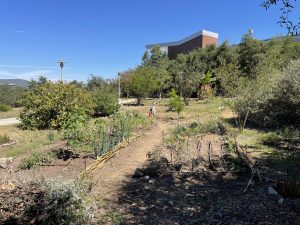
Milpa is a Mesoamerican polycrop farming practice of corn, beans, and squash, also known as “The Three Sisters” in North America. The practice dates back over 9,000 years and remains culturally significant to Indigenous communities throughout Mesoamerica.
Dr. Erika Díaz-Almeyda began the volunteer activity by introducing the concept of tequio, which refers to the collective work of Indigenous peoples in Mexico to support their communities. Tequio has Nahuatl origins and roughly translates to “tribute.” Although collective work existed for thousands of years prior to Spanish colonization, Spanish colonists appropriated and distorted the term in order to institute a labor tribute system. Tequiois still practiced throughout Indigenous communities today.
Dr. Díaz-Almeyda also acknowledged that it is still people of color who take care of the land and are knowledge keepers. She honored the life of Martin Lucas, a 40-year-old landscaper who was shot and killed in Fallbrook. Many people in the North County community, including Díaz, believe the murder was a hate crime, despite the murderer not being charged with any hate crimes.
Volunteers with the milpa had the opportunity to plant crops, sow seeds, pull weeds, check inventory, and perform other acts of garden maintenance. Each volunteer left with a bundle of Mexican bush sage gathered from the garden.
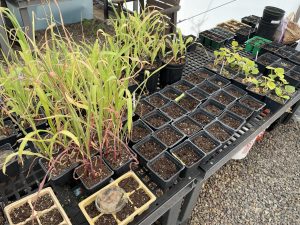
Melissa Chico served as a peer leader for the North County Day of Service. As a Biology major and student in Dr. Díaz-Almeyda’s lab, she helped start a club called Milpa Comunidad, which has brought together a community of students who support the milpa.
“This work couldn’t have been done without everyone. Milpa is about community, the plants—and we cannot forget about humans. Humans are a really big part of the milpa, and I’m really happy that a lot of people were able to show up, participate in this, and just see how the milpa works with everyone together,” Chico said.
For more Cougar Chronicle coverage of the milpa at CSUSM, see the links below:
https://csusmchronicle.com/24674/features/milpa-comunidad-celebrates-dia-de-los-muertos-at-csusm/