

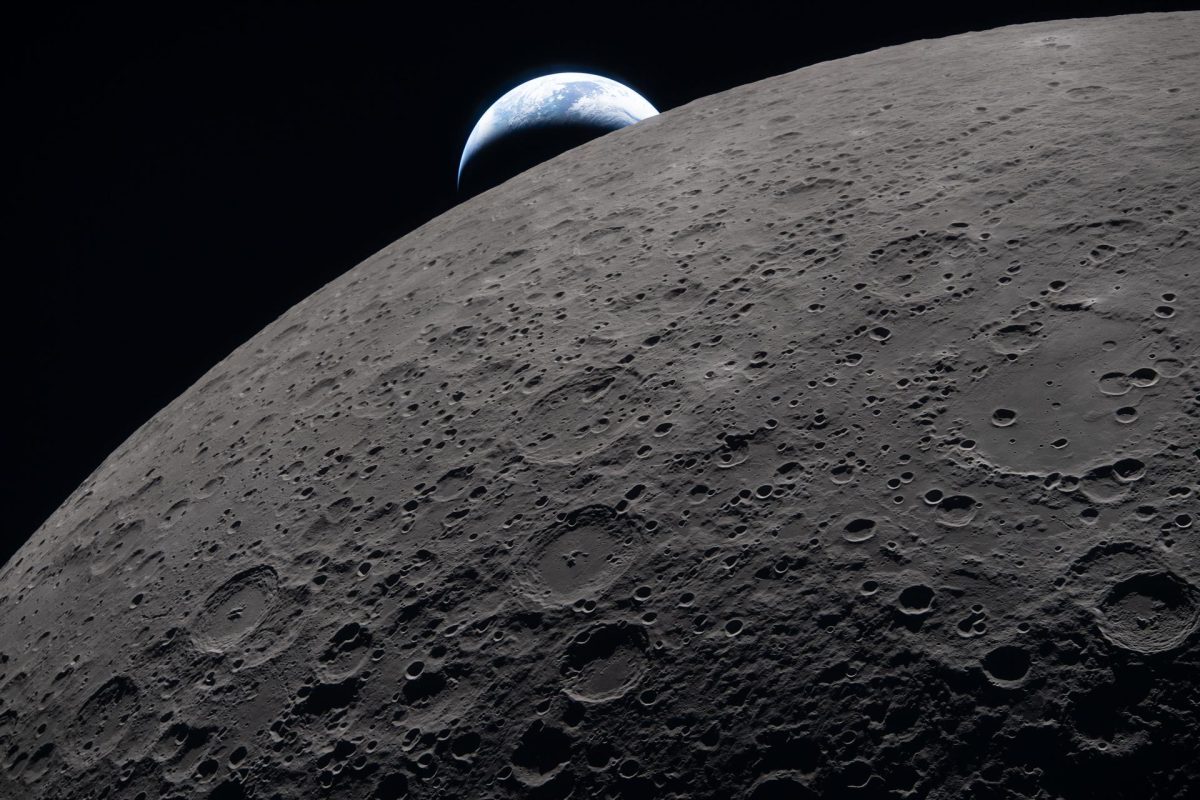
Humanity has so much to celebrate for Earth Day this year. Alongside all of our hardships, NASA’s newest space mission, Artemis II, reminds us of all the good we can do and everything that humanity can achieve.
On April 1, NASA launched the Artemis II mission with the Integrity Orion spacecraft from the Kennedy Space Center in Florida. The mission was a 9-day trip for a crew to fly by the moon and map out the surface to prepare for future moon missions. The mission landed safely off the coast of San Diego on April 10, and Earth welcomed the astronauts’ home. The astronauts chosen for the mission are Reid Wiseman the commander, Victor Glover the pilot, Christina Koch, mission specialist, and Canadian Space Agency astronaut Jeremy Hansen, mission specialist.
Artemis II is the next step in a decades-long plan to establish a scientific moon colony, which will be the start of our journey to Mars. “NASA is investing in a long-term exploration campaign of the Moon, which will lead to Mars, connecting near-term achievements with the technologies, science, and partnerships necessary for sending the first people to another planet.” The next mission, Artemis III, set to launch in 2027, will “test rendezvous and docking capabilities between Orion and private commercial spacecraft needed to land astronauts on the Moon.”
This is a huge step for our scientific progress and our place in the universe, but what does it mean for everyone else on Earth? Something we can appreciate about the mission is the multiple records broken, including the farthest human spaceflight from Earth.
The world can also celebrate the first ever woman and person of color to orbit the moon, as well as the first non-American, as Hansen is from the Canadian Space Agency. While these are massive achievements with their significance reaching outside the scientific community, astronaut Victor Glover said in a press event, “It’s about human history. It’s the story of humanity — not Black history, not women’s history — but that it becomes human history.”
Additionally, across hundreds of streaming sites and news organizations, the Artemis II launch was watched live by over 10 million viewers around the world, “making it the most-watched launch in NASA’s history and one of the largest livestreamed events overall.” Tens of thousands of people continuously watched livestreams of the Integrity crew during the nine-day journey and of mission control on Earth. Livestreams and constant coverage allowed the world to be closer than ever to a moon mission.
A new term was coined in 1987 called the “overview effect”, or the perspective shift that astronauts, and even watchers on Earth, can experience from being on space missions or seeing pictures and videos of our pale blue dot from space. It describes the indescribable amazement and awe that comes from seeing our world with a new lens.
However, NASA mission control has come up with a new phrase following the Artemis II mission: “moon joy”, or the awe and happiness that the four astronauts were feeling as they saw the moon from its own orbit, which is the first time in 50 years anyone has seen it. “It’s not just a poster in the sky that goes by — it’s a real place” Christina Koch said.
The astronauts recounted the unique hills, valleys, and other landmarks that we can’t see on our side of the moon, with so much wonder, and mission control’s Jacki Mahaffey replied “Copy, moon joy”.
Earth deserves some moon joy right now.
One of the ways NASA is giving moon joy to the world is through photography. Their galleries are filled with hundreds of photos of the launch, flyby, splashdown, and everything in between during this mission. These collections are proof of the artistic instinct to capture what amazes us and share it with everyone else. It’s hard to scroll through dozens of photos of the moon, taken by people who have dedicated their lives to exploring it, and not be overcome with moon joy. These scientists, delivered to space with decades of science, used art to catch the overwhelming emotions it brought them.
Science is our mission to understand the world around us, and art is our mission to understand ourselves. The Artemis endeavors are not just special for the science communities, but for everyone who wants to know the unknown. That curiosity is how society progresses. It’s how we’ve gotten this far and how we’ll keep moving forward. It is humanity itself, captured in one image.
“A crew is … a group that is in it all the time, no matter what, that is stroking together every minute, with the same purpose, that is willing to sacrifice silently for each other, that gives grace, that holds accountable. A crew has the same cares and the same needs, and a crew is inescapably, beautifully, dutifully linked…I know I haven’t learned everything that this journey has yet to teach me, but there’s one new thing I know, and that is, Planet Earth, you are a crew,” Christina Koch said in a NASA press event.
Jeremy Hansen also said, “Our purpose on the planet as humans is to find … the joy in lifting each other up by creating solutions together instead of destroying.”
The Artemis missions aren’t about how far we can get from Earth, but what humans can accomplish. It’s about Earth. It’s always been about Earth.